
Access Charlotte County Police Blotter Records
Charlotte County police blotter records are maintained by the Charlotte County Sheriff's Office in Charlotte Court House, Virginia. The Sheriff's Office logs all incident reports, arrests, and law enforcement calls across this south-central Virginia county. If you need to search for a specific incident or arrest, you can submit a written FOIA request to the Sheriff's Office or use the Virginia court search tools to track cases that came out of blotter activity in the county.
Charlotte County Overview
Charlotte County Sheriff's Office
The Charlotte County Sheriff's Office on Waterworks Road serves as the sole law enforcement agency for the county. Deputies patrol the rural roads and communities that make up this largely agricultural area in south-central Virginia. All calls for service are dispatched through the Sheriff's Office, and all resulting incident reports and arrest records are filed there. The office is also where you go to ask about sex offender registration compliance in the county.
Charlotte County lies along the Virginia-North Carolina border region, south of Appomattox and west of Lunenburg. It is a quiet rural county with modest population and a small agency that serves a close-knit community. Larger investigations may involve the Virginia State Police, particularly for crashes on state roads or multi-agency drug cases. When the VSP is involved, they also hold records that may not be at the Sheriff's Office.
| Agency | Charlotte County Sheriff's Office |
|---|---|
| Address | 222 Waterworks Rd, Charlotte Court House, VA 23923 |
| Phone | (434) 542-5141 |
| Emergency | 911 |
| Website | charlottecountyva.gov/departments/sheriff |
How to Request Charlotte County Blotter Records
Virginia's public records law, the Freedom of Information Act under sections 2.2-3700 through 2.2-3714, governs access to Charlotte County Sheriff's Office records. This law says public records are open by default. If the office wants to withhold something, it has to point to a specific code section that justifies that decision. The law is written to favor disclosure over secrecy.
Send your request in writing to the Sheriff's Office. You can email, fax, or mail it. State what you are looking for as clearly as possible: the date, the location, the type of incident, and any names you know. The office has 5 business days to respond after receiving your request. The day they get it does not count. Day one is the next working day. If more time is needed, they must send you a written notice saying so and give you a new deadline.
Copy fees may be charged for records that run many pages. Virginia law lets agencies charge the actual cost of reproduction and the staff time needed to find the records, but only if that time is significant. For short requests, fees are usually low or waived. If the cost will be more than a small amount, the office should tell you before they start pulling records so you can decide whether to proceed. Ask about their fee schedule when you submit your request.
Exemptions that commonly apply to police blotter records include active investigation materials under section 52-8.3 and criminal history records under section 19.2-389. Both categories have specific limits on what can be released and to whom. Incident reports for closed cases are generally available. Records where a victim is a minor may have identifying information removed before release.
Note: Accident reports can be requested separately under Virginia Code section 46.2-379 by persons involved in or with a direct interest in the crash.
Charlotte County Police Blotter Cases and Court Records
When a Charlotte County arrest leads to charges, those cases go into the Virginia court system. General District Court handles misdemeanors and preliminary hearings on felonies. The Virginia General District Court case search lets you look up cases by defendant name, case number, or hearing date. If someone was arrested based on a blotter entry you found, this is a good first stop to see what happened next.
Felony prosecutions move to Circuit Court. The Charlotte County Circuit Court handles the most serious criminal cases in the county. You can search those cases through the Virginia Circuit Court case information system. Criminal cases use the CR prefix in the case number. Enter the defendant's last name and the year to bring up matching results. The system shows the full docket from the first entry through sentencing or dismissal.
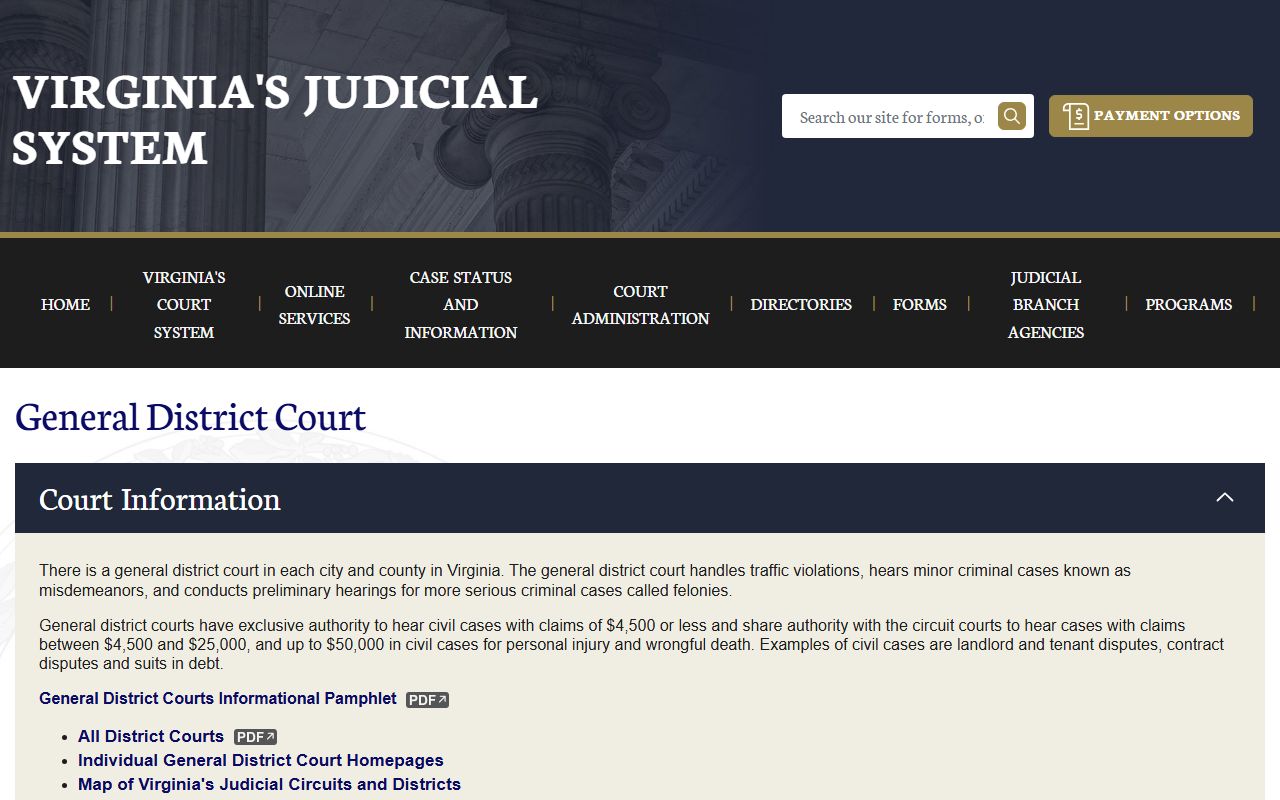
The Virginia General District Court search portal is a free public tool for tracing Charlotte County police blotter incidents through the misdemeanor and traffic court system.
Sex Offender Registry for Charlotte County
The Virginia Sex Offender and Crimes Against Minors Registry is maintained by the Virginia State Police and is searchable by the public at no cost. The Charlotte County Sheriff's Office handles local registration duties and ensures that offenders living in the county are properly enrolled in the state registry. The registry is updated regularly. You can search by name, ZIP code, or geographic area to find offenders registered in Charlotte County.
Virginia assigns offenders to one of three tiers based on the nature of the offense. Tier III offenders face the strictest requirements, including lifetime registration with quarterly address verification. They also face residency restrictions under Virginia Code section 18.2-370.3 that bar them from living within 500 feet of schools or childcare centers in certain situations. Tier I and II offenders have less frequent verification requirements and may petition to be removed from the registry after 15 or 25 years, respectively.
Nearby Counties
Charlotte County borders several counties in southern Virginia. Law enforcement near county lines may involve the Sheriff's Office of an adjacent county.